
Magic Bullet Is Leaking: Causes & Fixes (Gasket, Blade Assembly, Cup Threads)
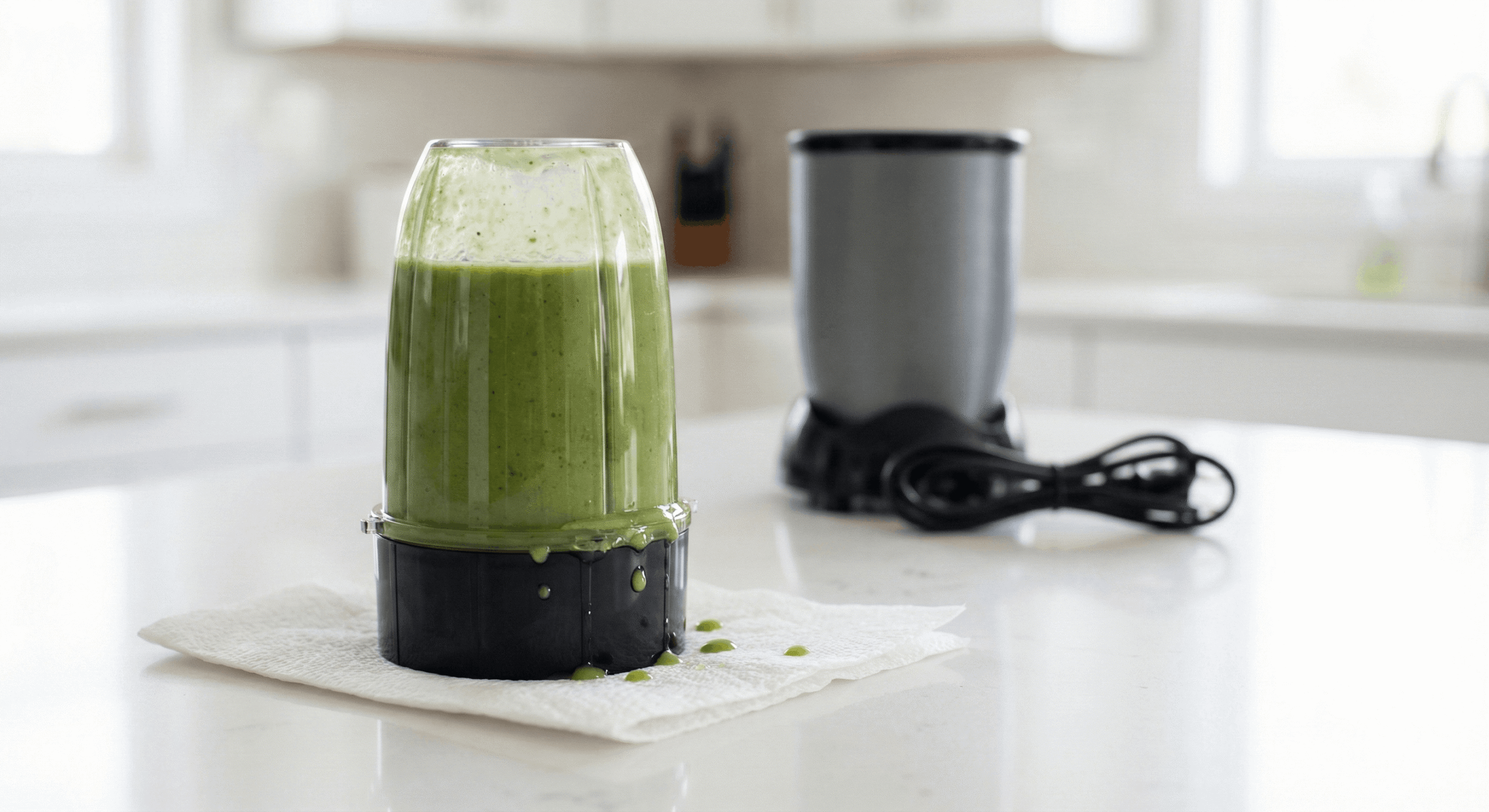
If your Magic Bullet is leaking, the fix depends on where the liquid escapes.
TL;DR
If your Magic Bullet is leaking, the fix depends on where the leak happens. Start with the fast checklist: unplug the base, dry everything, reattach the blade assembly straight, and check the gasket/seal is flat and seated. Most leaks come from misalignment, a shifted/worn gasket, dirty threads, or overfilling/thick blends. If liquid reaches the power base, stop using it, unplug, wipe dry, and let it dry completely – never rinse or immerse the base. If it still leaks after a water-only test, inspect parts for damage and replace the worn gasket/blade/cup (after confirming compatibility).
Listen to a brief summary of the article
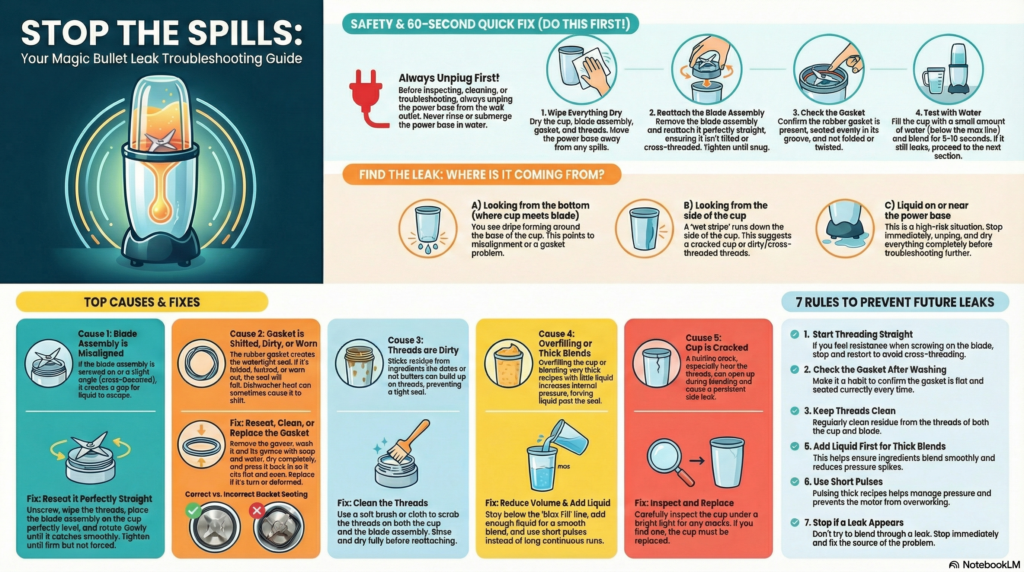
If your Magic Bullet is leaking, the fix depends on where the liquid escapes. Most leaks are caused by one of four things:
- Blade assembly isn’t seated evenly (tilt/cross-threading)
- Gasket/seal is shifted, dirty, worn, or missing
- Threads are dirty (residue prevents a tight seal)
- Overfilling / very thick blends increase pressure and push liquid toward the seal
This guide follows a symptom → cause → fix method so you can solve it quickly and safely.
Safety first: Unplug the power base before cleaning or troubleshooting. Never immerse or rinse the power base. If liquid reaches the base, stop and dry it completely before reuse.
Watch the video of the article
video instructions
Quick Fix in 60 Seconds (Do This First)
- Unplug the power base and move it away from any liquid.
- Wipe everything dry: cup, blade assembly, gasket area, and threads.
- Remove the blade assembly and reattach it straight (no tilt). Tighten until snug.
- Check the gasket/seal: confirm it’s present, seated evenly, and not folded.
- Test blend water only for 5–10 seconds (below any max fill line on your cup).
If it still leaks after this, use the sections below to pinpoint the cause.
Leak Troubleshooting Table (Symptom → Cause → Quick Check → Fix)
| Symptom | Most likely cause | 30-second check | Fix | Replace / Support when… |
| Leaks from bottom (cup meets blade) | Misalignment or gasket seating | Is assembly attached straight? Is gasket flat? | Reseat gasket; reattach straight; tighten snug | Gasket torn/deformed; leaks persist after water test |
| Leaks down the side | Cross-threading or dirty threads | Do threads look clean? Did it tighten smoothly? | Clean threads; reattach carefully | Cup cracked/warped; persistent side leak |
| Leaks only with thick recipes | Pressure/viscosity | Does it leak with water-only test? | Add liquid; reduce volume; pulse | If leaks with water too → gasket/alignment issue |
| Leak started after dishwasher | Gasket may have shifted | Is gasket seated evenly? | Reseat gasket; dry fully | Gasket won’t sit flat or looks warped |
| Liquid near power base | Spill or leak reached base | Any moisture under cup/base area? | Stop, unplug, wipe, dry completely | Repeats; base smells hot/acts oddly – contact support |
Step 1: Find Where It Leaks (The Symptom Matters)
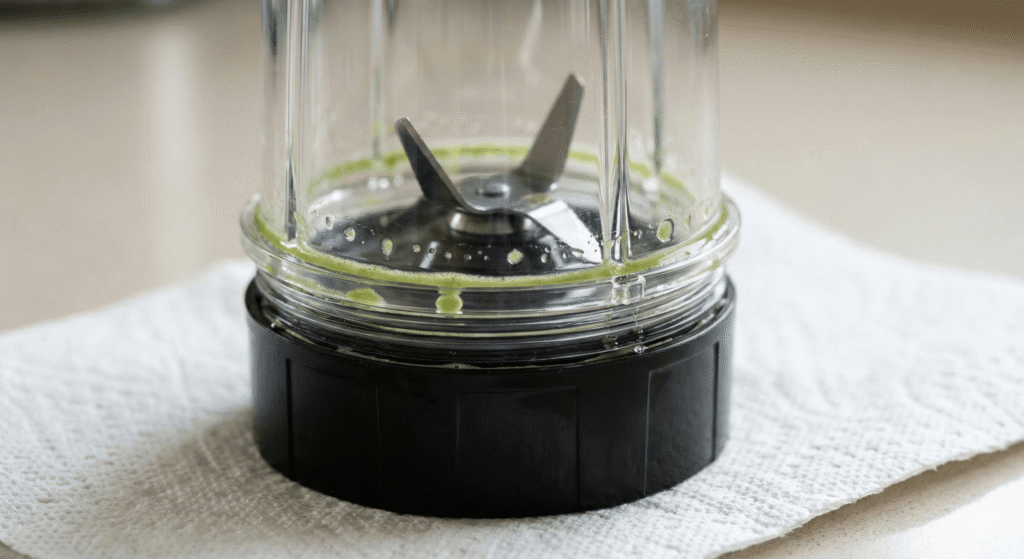
A) Leaking from the bottom (where cup meets blade assembly)
How it looks
- Drops forming around the underside of the cup
- Liquid collecting around the blade assembly
- Drips that appear during blending or immediately after
Most likely causes
- Blade assembly is slightly misaligned (tilt/cross-thread)
- Gasket isn’t seated flat or is worn
- Threads have residue and aren’t tightening fully
What to do next
- Go to: “Blade assembly isn’t seated evenly” and “Gasket shifted/worn”
B) Leaking from the side (around the cup threads)
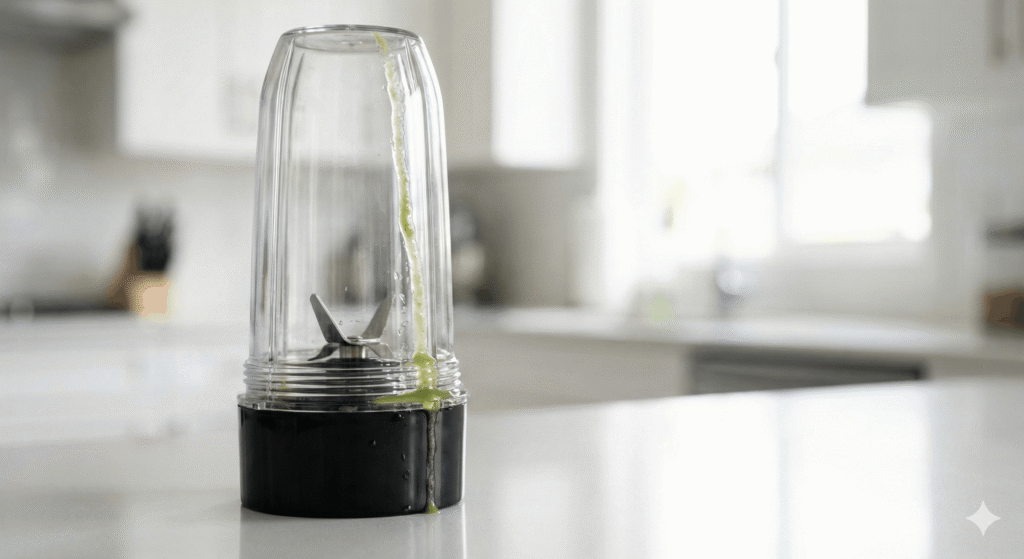
How it looks
- Liquid runs down one side of the cup
- You see a “wet stripe” starting near the threads
Most likely causes
- Cross-threading (started at an angle)
- Debris on the threads
- Cup is cracked/warped near the threaded area
What to do next
- Go to: “Threads & cross-threading” and “Cracked/warped cup”
C) Liquid near/on the power base (motor base)
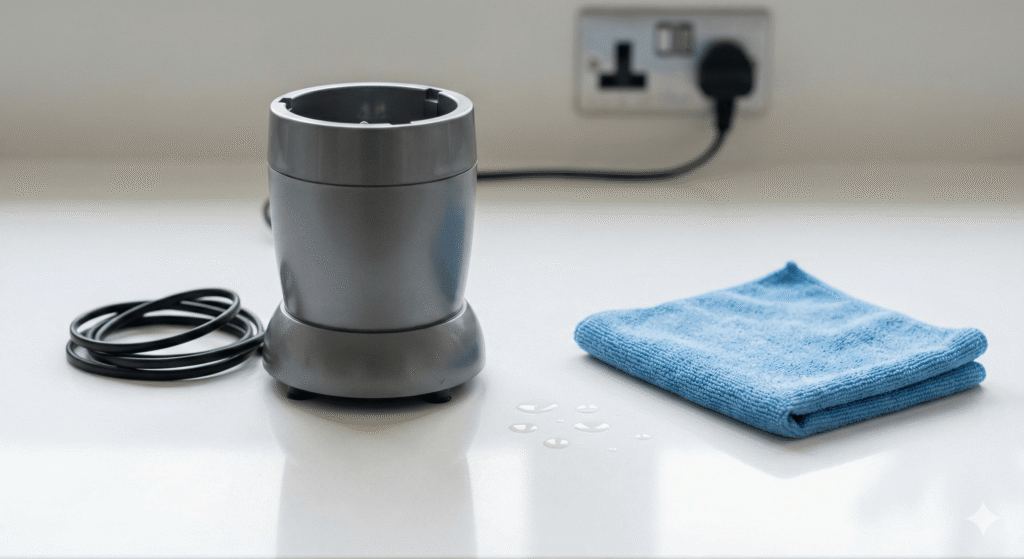
Treat as higher risk
- If liquid reaches the power base: stop immediately, unplug, wipe dry, and let it dry completely.
- Do not attempt to rinse the base.
- If this repeats or the base behaves unusually (smell/heat/erratic operation), contact support and stop using it.
Main Causes of Leaks (And How to Fix Each One)
1) Blade assembly isn’t seated evenly (minor tilt = major leak)

Why it happens
If the blade assembly starts threading at an angle, the seal won’t compress evenly. Even a small tilt can create a leak path.
Fix (reseat correctly)
- Remove the blade assembly
- Wipe the cup threads and blade assembly threads
- Place the blade assembly on the cup perfectly level
- Rotate slowly until it catches smoothly
- Tighten until snug (firm but not forced)
Avoid
- Forcing it when it feels “gritty” or crooked
- Over-tightening (can worsen alignment or wear)
2) The gasket/seal is shifted, dirty, worn, or missing
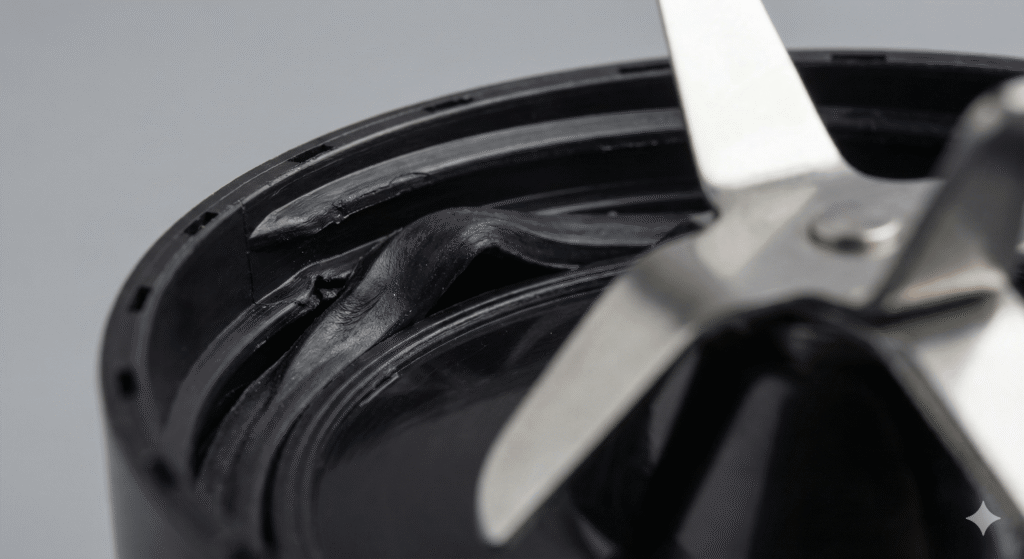
Why it happens
The gasket (rubber seal ring) is what creates the watertight seal inside the blade assembly. If it’s not seated flat or it’s damaged, liquid escapes under pressure.
Fix (reseat and clean the gasket)
- Remove the blade assembly
- Locate the gasket inside the blade assembly (in its groove)
- Inspect it: make sure it’s not folded, twisted, or partially out
- Wash the gasket and the groove area (warm water + mild soap), then dry completely
- Press the gasket back into the groove so it sits flat and even all the way around
- Reattach the blade assembly straight and test with water
Signs the gasket likely needs replacement
- Tears, cracks, or visible deformation
- It won’t stay seated in the groove
- Leaks continue even after reseating and cleaning
- You see liquid consistently escaping from the same spot
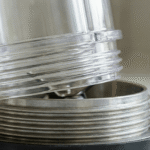
3) Threads are dirty (residue prevents sealing)
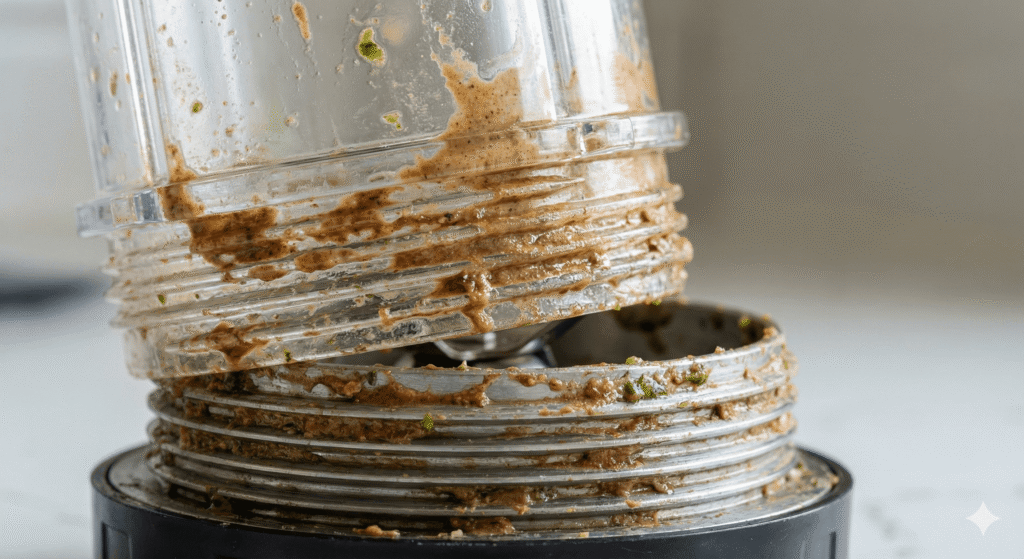
Why it happens
Sticky residue or fine particles on threads can prevent full tightening and allow liquid to escape.
Fix
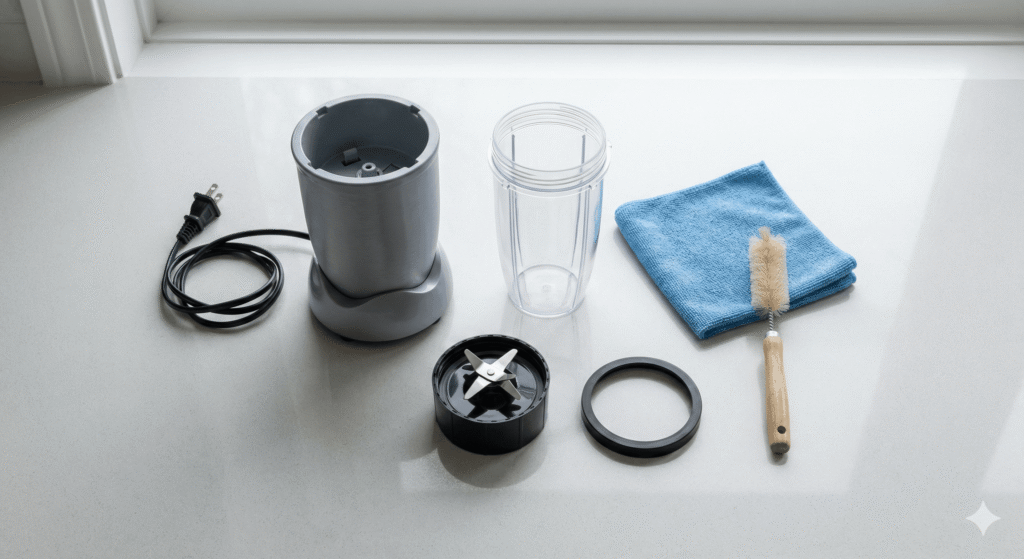
- Clean threads on both the cup and blade assembly using a soft brush or cloth
- Rinse and dry fully
- Reattach straight and snug
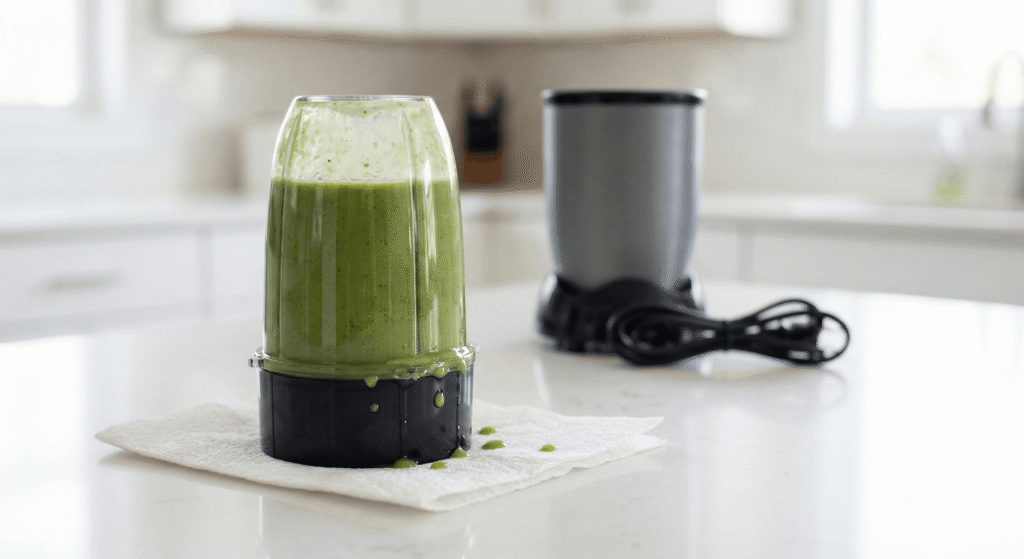
4) Overfilling or very thick blends increase pressure
Why it happens
Very thick blends (little/no liquid) and overfilled cups can increase internal pressure, pushing liquid toward the seal and threads.
Fix
- Reduce volume (stay below any max fill marking on your cup)
- Add enough liquid to allow smooth blending
- Use short pulses rather than long continuous runs
- If ingredients jam, stop, shake/stir (with the unit off), and restart in pulses
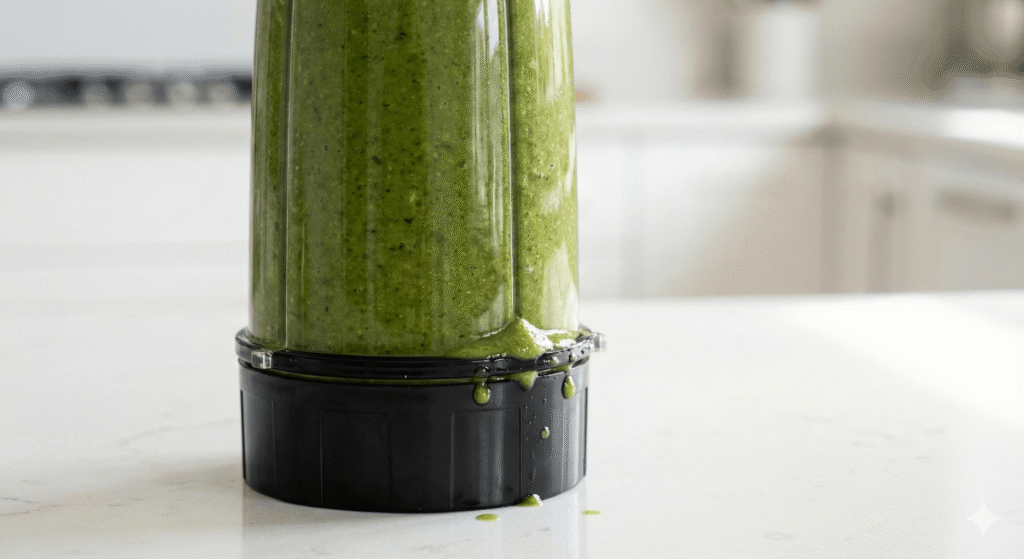
Typical “thick blend” scenarios that trigger leaks
- Nut butter–like textures
- Very thick dips/sauces
- Dense frozen blends without enough liquid
5) Dishwasher heat may shift the gasket (possible cause)
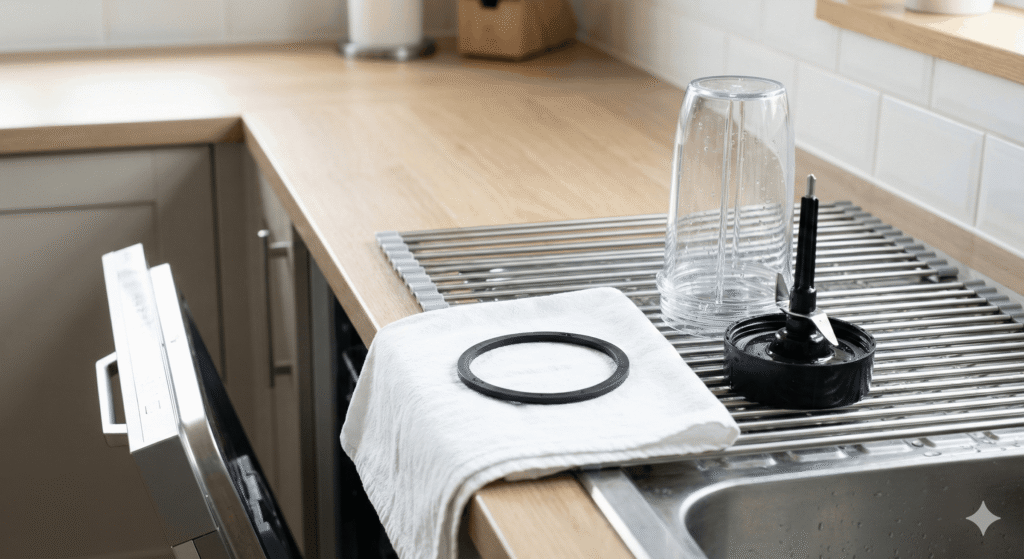
Important: This is not guaranteed, but if a leak starts right after dishwasher cleaning, it’s worth checking gasket seating and shape.
Fix
- After washing, always verify the gasket sits flat
- If the gasket looks warped or won’t sit correctly, replacement may be necessary
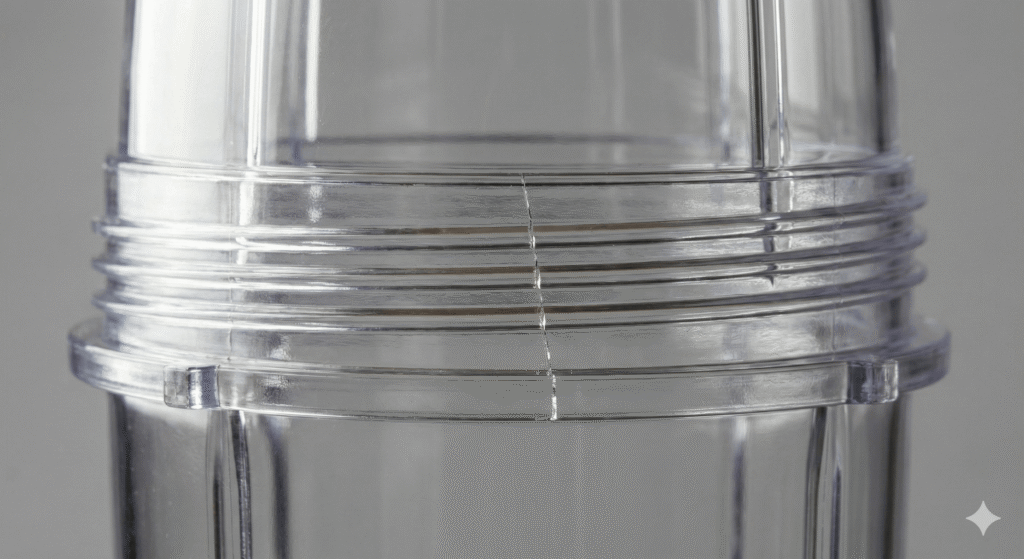
6) The cup is cracked or warped (especially near the threads)
Why it happens
Hairline cracks near the threads can open slightly during blending vibration and cause side leaks.
Fix
- Inspect the cup under strong light
- Look carefully around the threads and base
Replace the cup if you find cracks, chips, or warping
Add-on:Printable checklist (PDF/PNG): “Leak Prevention: 7 Rules” for quick reference.
Safety
- Unplug before cleaning or troubleshooting.
- Never rinse or submerge the power base. Wipe with a damp cloth only, then dry.
- If liquid reaches the base: stop, unplug, wipe, and allow to dry completely before reuse.
- Avoid blending hot liquids or carbonated liquids in closed containers, as pressure can build and increase risk (and can worsen sealing issues).
Site recommendation: Link this section to a dedicated Safety Center page.
Parts & Compatibility (What You May Need)
Depending on the cause, the most common replacements are:
- Gasket / seal ring
- Blade assembly
- Cup
Important: Compatibility can vary by model/generation. Do not claim universal fit unless verified.
Examples
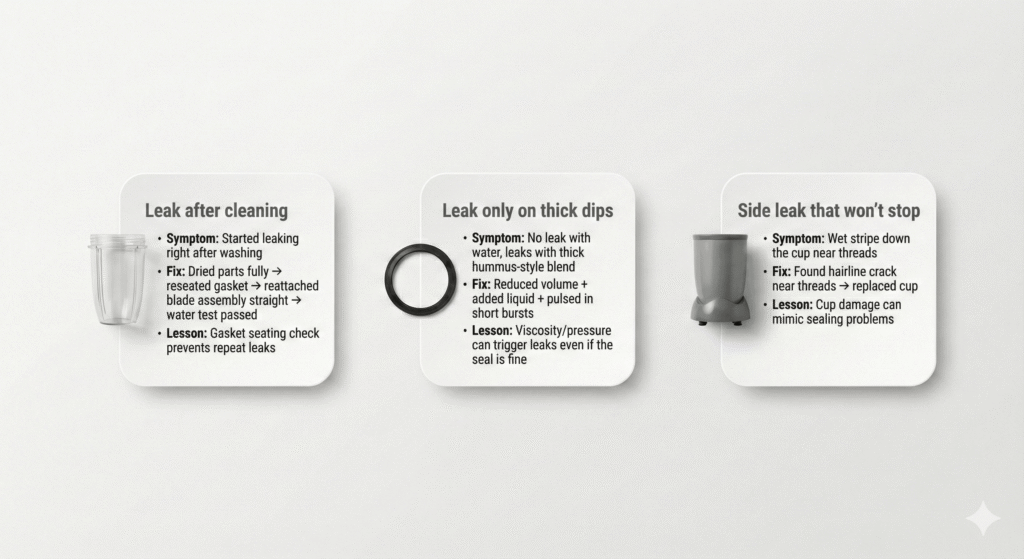
1: Leak after cleaning
- Symptom: Started leaking right after washing
- Fix: Dried parts fully → reseated gasket → reattached blade assembly straight → water test passed
- Lesson: Gasket seating check prevents repeat leaks
2: Leak only on thick dips
- Symptom: No leak with water, leaks with thick hummus-style blend
- Fix: Reduced volume + added liquid + pulsed in short bursts
- Lesson: Viscosity/pressure can trigger leaks even if the seal is fine
3: Side leak that won’t stop
- Symptom: Wet stripe down the cup near threads
- Fix: Found hairline crack near threads → replaced cup
Lesson: Cup damage can mimic sealing problems
Why is my Magic Bullet leaking from the bottom?
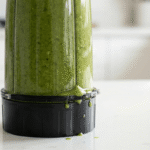
Most bottom leaks come from blade assembly seating or gasket issues: misalignment, residue on threads, or a gasket that’s shifted/worn. Reseat the gasket, clean threads, and reattach the blade assembly straight.
How do I know if the gasket needs replacing?
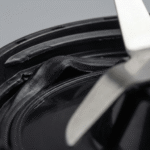
If the gasket is torn, cracked, deformed, or won’t sit flat in its groove, it may not seal properly. If leaks continue after cleaning and reseating, replacement is usually the next step.
Should I tighten the blade assembly harder?
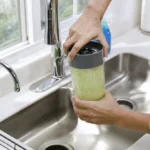
Tighten until snug and evenly seated. Forcing it can worsen alignment or wear. If it still leaks, focus on gasket seating, thread cleanliness, or part condition rather than extra force.
Why did it start leaking after the dishwasher?
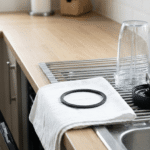
Dishwasher heat can be a possible trigger if it shifts or warps the gasket. Check that the gasket is seated flat and centered before blending. If it no longer sits properly, replace it.
What should I do if liquid reaches the power base?
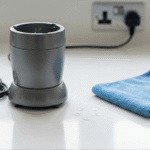
Stop immediately, unplug, wipe dry, and let the base dry completely. Do not rinse or immerse the base. If it happens again, contact support and stop using the unit.
Can thick recipes cause leaks?
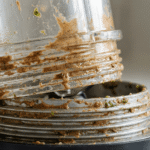
Yes – thick blends and overfilling can raise pressure and push liquid toward the seal. Reduce volume, add liquid, and use short pulses. If it leaks with water too, it’s likely gasket/alignment/part wear.
Can I replace just the gasket (not the whole blade assembly)?
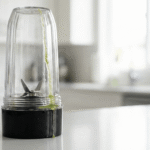
Often yes, but it depends on your model and how the gasket is designed. Confirm compatibility using your model identifier and the official parts list.
What if it leaks even with water-only testing?
That points to a mechanical sealing issue: gasket damage, misalignment, worn blade assembly, or cup damage. Inspect and replace the faulty part once compatibility is confirmed.